How Kei Takeuchi Let Hakuba’s Landscape Shape Every Decision
There is a particular discipline required to design a building in Hakuba. The mountains do not yield to architecture — they demand that architecture yields to them. Few understand this as instinctively as Kei Takeuchi, principal of Kei Takeuchi Architect & Associates, whose work on Miru Residences Hakuba began not at a drafting table but with a question: how does a building belong here?
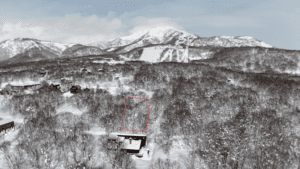
Miru Residences Hakuba is a premium ski-in, ski-out residential development located adjacent to the Happo-One lift station — one of the most coveted alpine positions in Japan. Developed by the SHC Group and managed by MIRU Collection, the project sits near the historic Hakuba Olympic ski jump and within easy reach of the village’s restaurants and onsen. But its ambition extends well beyond location. The building’s roofline traces the silhouette of the Hakuba Sanzan peaks. Its atrium echoes the deep crevasses of the Hakuba Daisekkei snow canyon. Its plantings draw exclusively from native Hakuba species. Every decision, from the hammered metal signage to the movable interior partitions, is rooted in place.
Takeuchi brings a personal history with Hakuba to the project — the mountains here shaped him as a child, and continue to challenge him as a practitioner. We sat down with him to discuss the thinking behind Miru Residences Hakuba: how the landscape dictated form, how Japanese spatial tradition was reinterpreted for a contemporary hospitality context, and what it means to expand a brand’s visual language through architecture rather than despite it.

What were the primary landscape features that dictated the building’s final form?
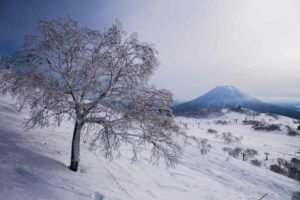
The most significant element is the majestic beauty of the ridgeline symbolised by the Hakuba Sanzan peaks. The roof form traces this silhouette, allowing the building to blend into the surrounding landscape while still carrying a presence that feels distinctly Hakuba. By avoiding a “back side” and shaping all four elevations with equal intention — including the view from the ski slopes above — we ensured a distinctive and beautiful profile that becomes part of the mountain scenery from every vantage point.
What were some of the specific design choices made to maximise Hakuba’s year-round appeal?
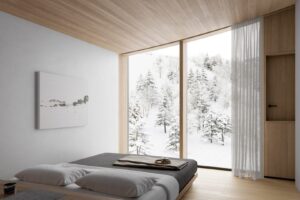
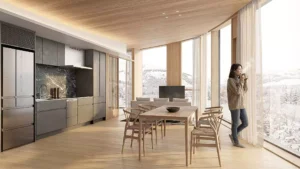
To ensure guests can experience Hakuba’s shifting seasons from within the rooms, we introduced picture windows that frame the landscape like living artworks — winter’s silver world, spring’s fresh greens, summer’s deep foliage, and autumn’s vivid colours. In the penthouse, the ceiling follows the roofline, creating a sense of the interior extending outward toward the mountains and enhancing the feeling of openness.
How does the design balance expansive mountain views with a sense of sanctuary and interior comfort?
Large openings capture the grandeur of the mountains, while the interiors are composed of soft materials and calm, muted tones that cultivate a sense of quiet. By intentionally omitting balconies, the picture windows act as framed compositions, allowing the dynamism of nature and the serenity of the room to coexist in a continuous, seamless experience.
Are there any subtle homages to the Nagano region or local craftsmanship to look out for in the design?
Yes. The movable interior partitions reinterpret traditional Japanese spatial concepts such as shoji and fusuma in a contemporary way. For part of the signage, we applied a hammered metal finish crafted by traditional Japanese artisans, evoking the fractured surfaces of Hakuba’s snowfields and the way light reflects across them.
How does this development evolve the Miru visual language?
This project expresses Miru’s core philosophy — a deep, attentive gaze toward the land — through architecture, landscape, and signage as an integrated whole. In an industry where brand identity often precedes place, we sought instead to let Hakuba’s unique climate, geology, and culture shape the design. By doing so, the project expands Miru’s visual language into something more three-dimensional and site-specific, becoming a Miru that could only exist here.
How did you ensure each unit feels like a private residence despite being part of a larger hospitality project?
Rejecting a layout defined by the repetition of identical rooms, the design embraces the surrounding landscape, making more than half of the units corner rooms with a generous sense of two-directional openness. The intention is to evoke the feeling of one’s own home within a hospitality setting. Through the active use of movable partitions, guests are invited to shape and compose the space in a way that reflects their individual style of stay.
How do the communal spaces adapt to the changing energy of the valley between the different seasons?
At the heart of the building is a multi-storey atrium inspired by the crevasses of the Hakuba Daisekkei. Natural light flows through this central void, bringing stillness in winter and openness in summer. It acts as a vessel that receives the valley’s seasonal changes and gently transmits them into the interior.
How does the building interact with or respect the immediate alpine ecosystem?
We preserved the existing terrain and vegetation as much as possible, and the new plantings focus on native Hakuba species such as Hakunbo, Kobushi, and Aohada. These trees reflect the region’s seasonal character and are well adapted to the climate, including snow-shedding forms that harmonise with the local environment.
Is there a specific architectural detail or vantage point that you feel truly defines this project?
The picture windows in each unit offer entirely different “paintings,” changing dramatically with the seasons. On the rooftop, the viewing terrace becomes a surreal experience in winter — when snow blankets the roof, it feels as though you are standing above the clouds, something we hope guests will experience for themselves.
What is your personal relationship with Hakuba?
Hakuba is a place my father brought me to when I was young, and I still remember thinking, “I can’t believe a place this beautiful exists in Japan.” It is a landscape that continually challenges me to consider how architecture can coexist with nature without diminishing it. Each visit reveals new expressions of the mountains, sharpening my sensibilities as an architect. Creating architecture here feels like an ongoing dialogue with the natural world.
A Building That Earns Its Place
What makes Takeuchi’s approach to Miru Residences Hakuba compelling is precisely what makes it rare in resort development: restraint deployed in service of presence. The building does not compete with the Hakuba Sanzan — it converses with them. The roofline echoes the peaks. The atrium holds light the way a snowfield does. The picture windows do not frame a view so much as invite the mountain inside.
For buyers and investors, this quality of architecture is not merely aesthetic. Buildings that are genuinely rooted in their setting — that belong rather than intrude — tend to hold their appeal across seasons and across market cycles. Miru Residences Hakuba, positioned at one of Happo-One’s most sought-after access points, offers ski-in, ski-out convenience alongside a design philosophy that treats the alpine environment as a collaborator rather than a backdrop.
As Hakuba continues to attract both domestic and international attention as a year-round destination, projects of this calibre represent something increasingly important: a template for what alpine development can look like when architecture is asked to do more than simply fill a building envelope.
Miru Residences Hakuba is developed by the SHC Group and managed by MIRU Collection. For enquiries on available residences, contact the Nisade team.