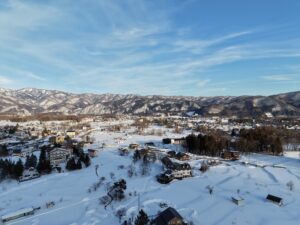
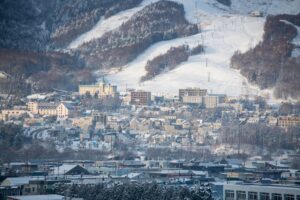
For three years running, one small mountain village in Nagano Prefecture has outpaced every other location in Japan on a single, closely watched government metric: the annual rise in roadside land value. Not Tokyo. Not Osaka. Hakuba.
It’s the kind of statistic that’s easy to skim past in a press release and easy to overstate in a sales brochure. So it’s worth asking plainly: what does the data actually say, where does it come from, and what does it mean for anyone weighing an alpine property investment in Japan right now?
Three Years of Data, One Direction
Each July, Japan’s National Tax Agency publishes its rosenka — the roadside land valuations used to calculate inheritance and gift tax nationwide, assessed as of January 1 each year. It’s a tax benchmark, not a transaction price, and it typically sits below open-market value. But because it’s calculated the same way, at the same time, everywhere in the country, it’s one of the cleanest year-on-year comparisons available for where land values are actually moving.
For 2024, 2025, and 2026, that comparison has told the same story:
- 2024: +32.1% — Hakuba’s benchmark point recorded the largest rosenka increase in Japan.
- 2025: +32.4% — a second consecutive national #1.
- 2026: +32.7% — a third straight year atop the national rankings, confirmed in this year’s NTA release.
Three consecutive years at the top of a national ranking is no longer a spike. It’s a trend line, and it’s one the tax authority itself has now flagged three years in succession.
Measuring the Value Gap Against Niseko
This shift in market fundamentals matters most for buyers weighing where to enter — a question we’ve covered in detail in our guide to buying property in Japan. Against that context, a second, independent government dataset tells a complementary story. Japan’s Ministry of Land, Infrastructure, Transport and Tourism (MLIT) publishes its own land price survey, chika-koji, each March — assessed on the same January 1 date as the NTA figures, but calculated separately and released by a different agency entirely. Where the NTA sets a tax benchmark, MLIT’s figures are designed to track market value more directly.
The 2026 chika-koji results placed a commercial benchmark point in Happo-One third nationwide for growth, up 35.2% year-on-year, alongside a residential benchmark in Hakuba that recorded the single largest residential increase anywhere in Japan, at 33.0%.
Set those figures against price levels and the gap becomes concrete. Hakuba’s average across its three MLIT benchmark points sits at roughly ¥25,557 per square metre — worth noting as a comparatively thin sample, still developing relative to a more established market, but directionally consistent with the rosenka trend above. Niseko’s gateway town of Kutchan, by contrast, averages roughly ¥120,750 per square metre across its four points — nearly five times higher.
Two independently run government datasets, calculated on different methodologies, are now pointing the same direction: Hakuba is growing faster from a meaningfully lower base. For investors, that combination — lower entry cost, steeper trajectory — is what drives capital-gain velocity, and it’s compounded by a shift in how the market itself is used. What was once a winter-only ski hill now draws visitors year-round, for hiking, mountain biking, and trail running through the warmer months, alongside continued growth in international arrivals and regional infrastructure upgrades — all roughly three hours from Tokyo by car or train.
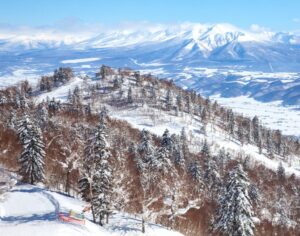
At Happo-One specifically, where the mountain’s terrain leaves genuinely little room for new slope-side development, that value gap is at its most pronounced.
Building in a Tightening Market
None of this is happening in isolation from what’s going on in Japan’s construction sector more broadly, and it’s worth being direct about the pressure developers are under nationwide. Turner & Townsend’s 2026 forecast puts average Japanese construction cost inflation at 5.3% for the year, easing only gradually through 2027, driven by persistent labour scarcity and material cost volatility. That scarcity has a specific cause: an April 2024 cap on construction-sector overtime — dubbed the “2024 problem” in the domestic industry — has sharply constrained available labour just as demand has climbed. A January 2026 Nikkei Asia poll found close to 70% of large and mid-size Japanese contractors said they would be unable to take on new large-scale projects this fiscal year as a direct result. It’s a dynamic we’ve tracked closely in Niseko too, where rising build costs have reshaped how developers plan and price new projects, and the same pressures apply wherever construction is underway in Japan’s alpine markets.
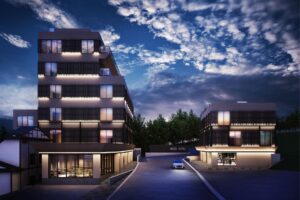
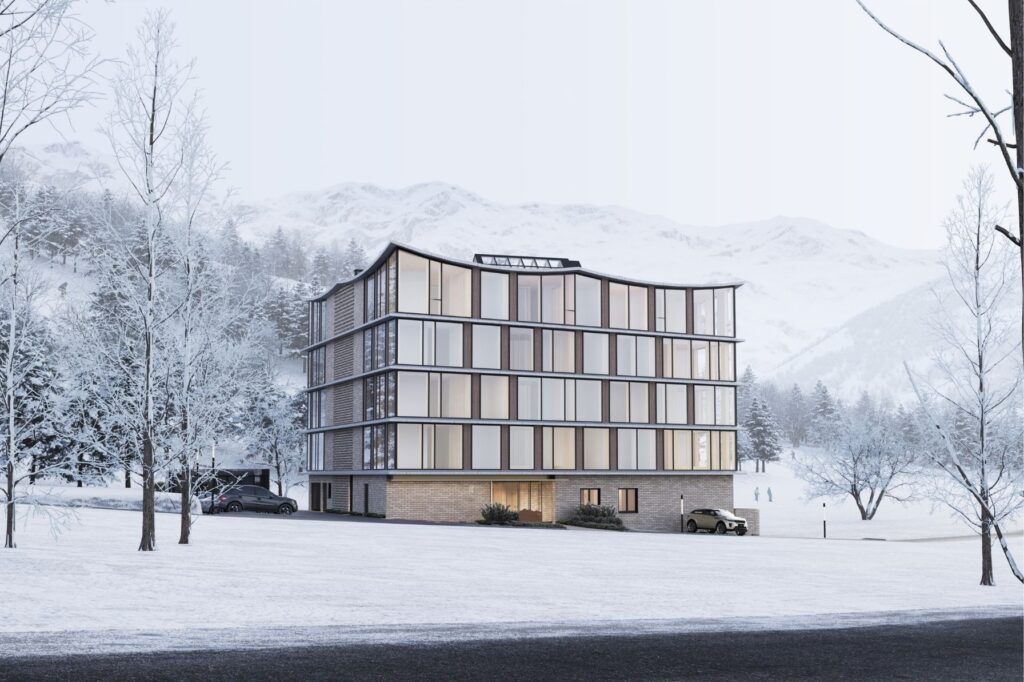
Against that backdrop, genuine ski-in/ski-out inventory in a location like Happo-One isn’t scarce because of marketing positioning — it’s scarce because the terrain that makes it valuable is also what limits how much of it can ever be built. Happo-One’s most recent example of that narrowing window is Miru Residences, a 30-unit development directly beside the lift station, currently on track for completion in October 2027 — ahead of whatever further cost escalation the next construction cycle brings.
What the Data Actually Supports
Three consecutive years of NTA data, a corroborating and independently calculated MLIT dataset, a price gap still open relative to Japan’s most established alpine market, and a construction sector that is measurably constraining new supply — together, these don’t prove any single property is a good investment. What they do establish is a market moving in a clear, government-documented direction, at a stage where entry points remain meaningfully lower than in comparable resort towns.
For investors weighing where in Japan’s alpine property market that combination of trajectory and value still exists, Hakuba — and Happo-One in particular — is where the current data points most directly.
Key Takeaways
| Data Point | Figure | Source |
| Rosenka growth, 2024 | +32.1% — #1 nationally | National Tax Agency |
| Rosenka growth, 2025 | +32.4% — #1 nationally | National Tax Agency |
| Rosenka growth, 2026 | +32.7% — #1 nationally, 3rd consecutive year | National Tax Agency |
| Happo-One commercial land growth | +35.2% — #3 nationwide | MLIT chika-koji |
| Hakuba residential land growth | +33.0% — #1 nationwide | MLIT chika-koji |
| Average land value, Hakuba | ~¥25,557/sqm (3 benchmark points) | MLIT |
| Average land value, Kutchan/Niseko | ~¥120,750/sqm (4 benchmark points) | MLIT |
| Japan construction cost inflation, 2026 | 5.3% national average | Turner & Townsend |
| Contractors unable to take new large projects | ~70% | Nikkei Asia poll, Jan 2026 |
| Miru Residences Hakuba | 30 units, ski-in/ski-out at Happo-One, completion Oct 2027 | Nisade |
For a broader look at how overseas buyers are approaching Japanese property right now, see our guide to Japan real estate investment strategy for foreign buyers.
Interested in current availability in Hakuba, including at Happo-One? Get in touch with the Nisade team for a private consultation, or browse current listings.