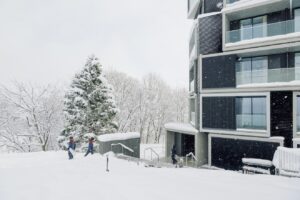
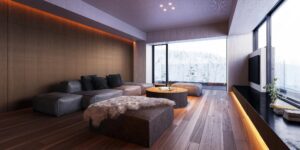
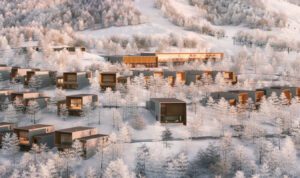
Perched just minutes from the Grand Hirafu Gondola, Powder Loft Niseko stands as a compelling example of architecture that transcends trends to create meaning and longevity in one of the world’s premier mountain destinations. Designed by acclaimed Japanese architect Makoto Nakayama, the project embodies a refined expression of Japanese modernism and minimalism – one that resonates quietly yet powerfully with the environment and lifestyle of Niseko.
In the following conversation, Nakayama discusses the ethos behind his work- grounded in simplicity, balance, authenticity, and a deep respect for natural forces. He unpacks how these principles informed his design for Powder Loft and why such an approach matters for the long-term value and identity of Niseko’s built environment.
1.) Could you please introduce yourself?
My practice originally started with residential projects, homes, and then commercial work. These days, we do a lot of hotels. That has become our main focus. And it’s not only in Japan. We’re also in conversations for overseas projects and have worked internationally as well. Personally, I try to embed Japanese aesthetics, philosophy, and even a kind of spirituality into my architecture. That’s really the backbone of what I do.
2.) Can you share about your practice?
In my own work, I aim for simplicity, and for a beauty that holds up no matter when you see it. Morning, evening, any time of day. I care deeply about whether architecture is truly beautiful across all light and all hours. It’s not about just filling a space with new, trendy, “cool” items. What matters is having an overall sense of balance. Everything has to work together.
3.) What makes Niseko fun to practice architecture in?
Honestly, from an architect’s point of view, the biggest reason Niseko is so attractive is simple. The clients have real financial capacity. You can talk about climate and other factors as well. But at the core, when you have clients who are truly well-funded and who specifically want you to design for them, it allows you to bring out your best work and really push the architecture further.
4.) How does Niseko’s natural elements influence your work?
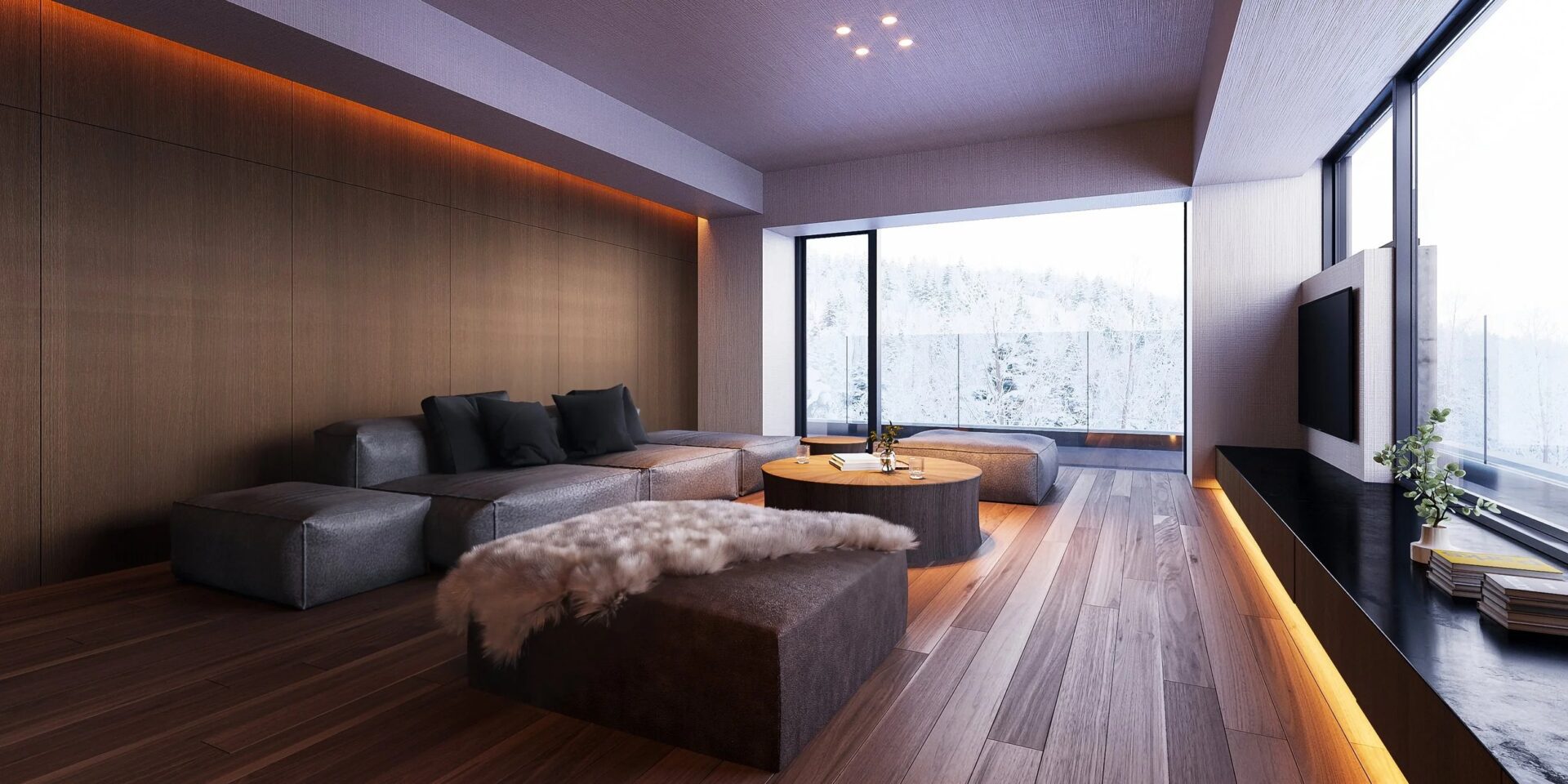
When you think about Niseko, and Furano as well, the natural conditions are intense. Dense forests, cold temperatures, heavy snowfall, and many environmental factors. And of course, as architects, it’s a given that we design buildings that can withstand all of that. It can’t be just “styling”. It can’t be only about making an exterior look fashionable.
We have to step back and think more fundamentally. First, architecture must protect people from nature. Then, from inside that protected shelter, the question becomes: how do you experience the landscape and enjoy the snow? That’s the challenge we’re trying to solve, and it’s the core objective of our work.
5.) How does good architecture influence long-term property value?
When we talk about asset value, or the “value” of architecture, it has to be something that holds up over a long horizon. Even as a building changes with time, its power shouldn’t fade. Ideally, it becomes increasingly beautiful as it ages. That’s the kind of value it needs to carry. A building that’s “beautiful at first, but once it gets dirty, people want to sell it”, that isn’t real architecture to me.
Real value includes everything. The interior, the exterior, the structure. It’s about creating an environment that people continue to love over decades. That’s the kind of architecture I’m trying to build. I think the key is to use genuine materials whenever possible, rather than cheap, flimsy, plastic-like finishes. Real materials are what give a building a timeless quality that doesn’t fade.
6.) What does the future of Niseko architecture look like?
Right now, when I look at Niseko as it is today, I’ll be honest. I’m not fully satisfied. I see it all around me. Why? Because it often feels like architecture here is being treated as nothing more than a byproduct of the economy. Of course, architecture is always connected to economics. But there’s a strong mindset, on both the developer side and the designer side, of “If it looks cool for a moment and sells fast, that’s enough.” But if Niseko is going to become a place with real global value, we need more authentic, enduring architecture.
If we create buildings that are essentially and fundamentally beautiful, the value of the place will rise much more. It could multiply many times over. So we need to commit to genuine architecture. And in many cases, that actually makes economic sense too. Less maintenance over time, for example. So there are real cost advantages. What’s needed is a stronger, long-term vision for the whole region. Niseko has the power to do that. I believe Niseko has that future.
7.) How do you balance a Japanese sensibility into your modern designs?
I think there’s a kind of Japanese DNA, a shared sensibility that many Japanese people carry instinctively. Things like wabi-sabi, and the spiritual mindset of Zen. I design while sensing those ideas, almost intuitively, thinking, “This is probably what it means.” And with wabi-sabi in particular, the most important point is that you can’t force it. You can’t fake it, and you can’t imitate it. It has to be real. And it has to be restrained. Humble, not showy, not excessive. Nothing unnecessary. Without that restraint, it stops being wabi-sabi.
What’s interesting is that there’s no single “correct answer”. It’s actually very free. But at the same time, people in Japan can usually tell whether something feels authentic or not. That’s why you don’t need to rely on traditional materials. Even something completely industrial, like stainless steel plates, can still express wabi-sabi. It comes down to balance, light, and the overall relationship between elements. And in Zen philosophy, this is a bit abstract, there’s the idea of taiji (対峙). To face something, to stand before it, to be present with it. The “other side” doesn’t have to be a person. It can be a landscape, or a building. You face it, receive it, and connect, almost heart to heart. It’s not conflict or confrontation in the fighting sense. It’s facing in a deeper sense. And if you can embody that, it becomes wabi-sabi. And it also becomes Zen.
8.) What’s your signature design element?
One element I use a lot, surprisingly, is a courtyard, even though many people don’t like the idea. It’s an outdoor space, but it sits at the center. An open-air inner courtyard. It’s not inside the room, but every space relates to it. And when snow accumulates there, then slowly melts, sometimes from reflected sunlight, the snow forms start to change shape. The snow masses become like objects, almost like sculptures. I find that transformation really fun.
9.) Where do you find your inspirations from?
Me personally, I tend to find inspiration from Japanese traditional Shinto and Buddhist shrines. Other than that, I also find inspiration from Japanese antiques.
10.) What’s your favorite building material?
One of my favorites, and something I use a lot, is the patina of rust on iron. I love how it changes over time. It starts out more yellowish, and as it develops it deepens and deepens, until it becomes this rich, deep orange. That gradual transformation is what I’m drawn to.
11.) Lately, who inspires you?
One person who really inspires me is Junko Koshino. She’s a friend, and also a client. She’s in her eighties now, but she still works actively, and her sensibility is incredibly sharp. That’s what I find so impressive. Junko Koshino is a very well-known fashion designer in Japan, and she has shown internationally as well, including Paris fashion shows in the past. She was recently awarded a national honor too.
Issey Miyake was also my senior. He is actually my senior from university. We went to the same school. He was in design and graphics, and I’m in architecture. But I really respect him.
12.) What’s your favorite project and can you tell us about it?
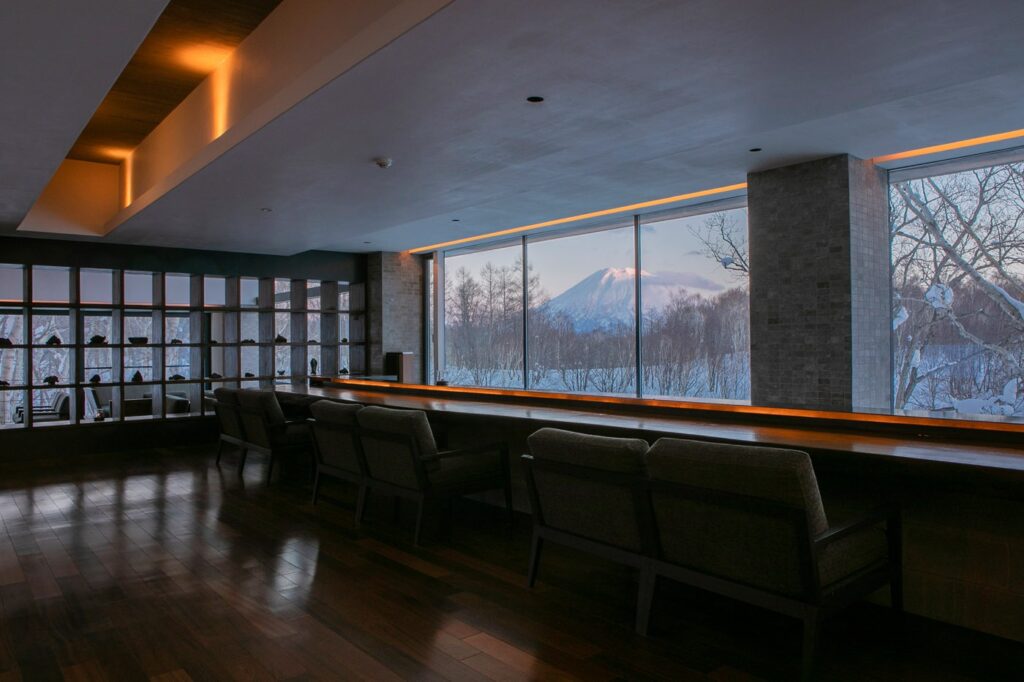
It has to be Zaborin. From any direction, the views are stunning. Even if you’re not looking toward Mt. Yotei, the forest is gorgeous, the pond is gorgeous. There’s basically no “bad” view anywhere on the site. But otherwise, the goal is for everyday human life to exist inside nature. To feel surrounded by it. It’s about carefully hiding what should be hidden, and letting what’s beautiful be seen at its absolute best. I think that impulse, wanting to curate what we see, comes from something deep in the human heart. And it creates a kind of rhythm in the experience.
For insights into how this kind of thoughtful architecture can elevate property value and lifestyle potential in Niseko, our team is here to help.
Reach out to learn more about Powder Loft, Nakayama’s vision, and how this project fits into the broader context of lasting, high-quality developments in the region.